
August 25th - September 14 2026
Location: Modal Gallery
Event Type: In-person
Price: Free
What can a uniform tell us about the people who wear it – and the society around them?
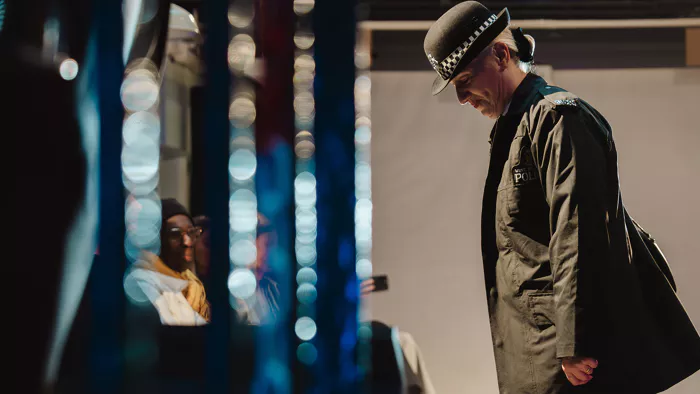
Fashion Police brings together reconstructed police uniforms, digital technology and personal testimony to explore almost two centuries of police uniform history.
The exhibition opens with a private launch at 5pm on August 25th (Tickets can be booked here).
The exhibition will then be open Monday-Friday 10am-5pm until September 14th.
Exhibition Information
The exhibition features 12 dressed mannequins alongside projected digital material and filmed oral histories, allowing visitors to encounter the garments themselves as well as the people, memories and social histories connected to them.
The exhibition draws on a collection of 24 recreated uniforms spanning policing history from the nineteenth century to the present day. Historic garments and archival material were studied through an interdisciplinary process combining garment reconstruction, digital pattern-making, 3D scanning and digital preservation. Fashion students and graduates recreated garments and patterns using tools including CLO 3D and Gerber, while computing and games students developed digital scans and digital twins of the uniforms.
By bringing physical reconstruction together with digital representation, Fashion Police moves beyond traditional displays to explore how uniform design has evolved in response to changing roles, technologies, working conditions and expectations of policing. Filmed oral histories add personal perspectives, bringing forward the experiences of those who wore the uniforms and the communities who encountered them.
Developed as a community-focused collaboration between Birmingham City University and the West Midlands Police Museum, the project was supported by a £243,263 grant from The National Lottery Heritage Fund. It has brought together fashion and digital heritage practice through replica garments, digital records, oral histories, fashion-show performances, exhibitions and public engagement activity.
The project was originally developed and led by Professor Carlo Harvey at Birmingham City University, alongside Corinne Brazier, Manager of the West Midlands Police Museum. Following Harvey’s move to Manchester Metropolitan University in February 2025, project leadership at BCU was taken forward by Associate Professor Dr Mathew Randall. Harvey has remained involved through the project’s final phase, which concludes in September 2026.
The exhibition at Modal provides an opportunity to share the project’s outcomes with a Manchester audience, connecting its fashion, digital heritage and public engagement strands with the work of the School of Digital Arts and Manchester Fashion Institute.
Fashion Police invites visitors to look again at something designed to be immediately recognisable: the uniform. Moving between reconstructed clothing, digital representation and personal testimony, the exhibition explores how uniforms communicate authority and identity, how they change with society, and what they can reveal about the people and communities behind them.
Professor Carlo Harvey says of the exhibition, “Fashion Police has always been about using creative and digital practice to make heritage tangible and open up conversations about identity, authority and the people behind the uniform. Bringing the work to SODA, with support from Manchester Fashion Institute, is a great opportunity to share the project’s fashion, digital heritage and public engagement outcomes with a Manchester audience as it concludes.”
Fashion Police: Changing Perceptions via Uniform Heritage is a collaboration between Birmingham City University and the West Midlands Police Museum, supported by The National Lottery Heritage Fund. The project uses fashion reconstruction, digital scanning, digital twins, oral history and public engagement to explore the evolution and social meaning of police uniforms across almost two centuries of West Midlands policing history.
Acknowledgements
Original project Co-PI: Corinne Brazier
Original project Co-PI: Professor Carlo Harvey
Project leadership at Birmingham City University: Associate Professor Dr Mathew Randall
Project partners: Birmingham City University and West Midlands Police Museum
Funded by: The National Lottery Heritage Fund
Manchester exhibition: School of Digital Arts (SODA), Manchester Metropolitan University
With support from: Manchester Fashion Institute, Manchester Metropolitan University